Butterflies and Flowers Embroidery
A Designer’s First Look: Delicate Motion, Not Just Decoration
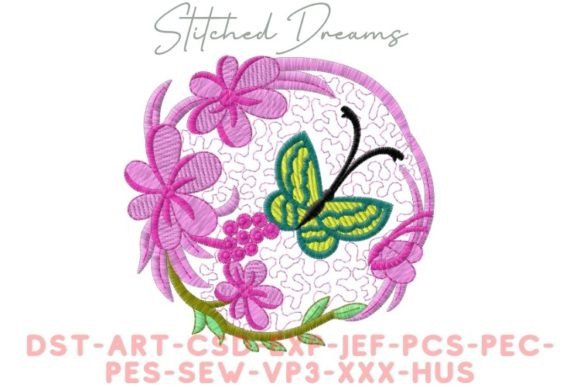
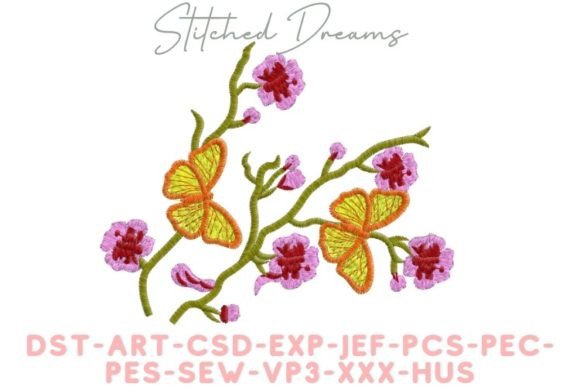
When I opened the Butterflies and Flowers Embroidery design on my machine software, what struck me wasn’t just prettiness—it was intention. This isn’t a cluster of generic florals with wings tacked on. The butterflies are posed mid-gesture: one tilted slightly as if landing, another with wings lifted in gentle asymmetry. Their wings carry subtle line work—fine running stitches suggesting veining—and soft fill-stitch gradients that shift tone without harsh edges. The flowers bloom with layered petal shapes, not flat silhouettes. As a designer who regularly selects embroidery files for client projects, I immediately saw its potential for pieces where charm and craftsmanship must coexist: baby blankets, linen pillow covers, boutique aprons, and personalized gifts meant to be cherished—not just worn.
Fits Naturally Into Real-World Projects
The Butterflies and Flowers Embroidery design feels purpose-built for small-to-medium hoop applications (think 4x4” or 5x7”), making it ideal for items with limited real estate: cap fronts, pocket accents on denim jackets, corner embroidery on kitchen towels, or centered motifs on toddler sweatshirts. It also scales well—without distortion—for larger placements like tote bag centers or nursery wall hangings. Because it lives in the Single Flowers category but includes integrated butterfly elements, it bridges botanical elegance with whimsy—perfect for Etsy sellers curating seasonal collections (spring launches, Mother’s Day bundles) or craft fair vendors building cohesive booth themes.
How It Performs Across Fabric Types and Use Cases
I tested Butterflies and Flowers Embroidery across several substrates: lightweight cotton poplin (for pillow covers), medium-weight terry (kitchen towels), brushed poly-cotton blend (baby blankets), and structured twill (caps). On stable fabrics with proper cutaway stabilizer, the satin-stitched flower centers held crisp definition, and wing outlines remained clean—even at 3mm width. On stretchy sweatshirt fleece, I added light tear-away + topping, and the design retained shape without puckering. For dark fabric, contrast mattered: using ecru thread on navy created soft sophistication; switching to metallic gold boosted visual impact for gift-ready items.
On curved cap surfaces, I repositioned the design slightly lower than center to avoid seam interference—and it stitched cleanly. Tiny details (like antennae and petal tips) stayed legible thanks to balanced stitch density—not so sparse they vanished, not so dense they bunched on lightweight linens. That balance makes Butterflies and Flowers Embroidery unusually versatile for commercial embroidery: it reads well in person *and* translates clearly in product photography, helping handmade shops elevate perceived value without over-engineering.
What This Design Adds to Your Handmade Product
Let’s be practical: customers don’t buy “a butterfly motif.” They buy meaning—gentleness, transformation, nostalgia, celebration. Butterflies and Flowers Embroidery carries that subtext without needing words. When stitched onto a muslin baby blanket, it signals care and attention to detail. On an organic cotton tote, it quietly reinforces brand values: natural, unhurried, artisanal. For Etsy sellers, this kind of emotional resonance improves conversion—especially when paired with strong printable mockups showing the design in lifestyle context (e.g., folded towel on a sunlit counter, pillow propped beside a teacup).
It also supports consistency. If you’re building a signature style—say, garden-inspired nursery decor—you can use Butterflies and Flowers Embroidery as a cornerstone design, then layer it with coordinating single-flower files or monogrammed initials. That cohesion builds buyer trust: shoppers begin recognizing your aesthetic, returning not just for one item, but for the whole world you’ve stitched into being.
Practical Notes Before You Stitch
Before committing to a customer order, always:
- Test on scrap fabric matching your final substrate—and use the same stabilizer combo you plan to run.
- Check thread color contrast, especially for tiny wing details. A 10% shift in hue can make fine lines disappear on dark backgrounds.
- Review stitch density in your software. If you see overlapping fill areas or tight satin columns under 2mm, consider simplifying one element—or confirm whether alternate versions (like a low-density variant) exist on the Creative Fabrica product page.
- Confirm hoop size requirements. While this design fits comfortably in a 4x4”, verify exact dimensions in the file metadata before digitizing for a specific machine.
- Compare light/dark fabric mockups side-by-side. What reads delicately on ivory may feel washed out on heather gray.
- Inspect small details post-stitch: antennae, wing edges, and stamen tips should be fully formed—not frayed or skipped. If they’re inconsistent, your tension or needle may need adjustment.
- Double-check licensing terms on the Creative Fabrica product page. Since this is an Embroidery file intended for physical finished products, confirm whether resale of embroidered items is permitted—and whether credit or attribution is required.
Final Thoughts for Designers and Sellers
Butterflies and Flowers Embroidery won’t replace complex multi-part applique designs—but it doesn’t try to. Its strength lies in quiet confidence: refined execution, thoughtful spacing, and a mood that lands every time. For apparel decorators, it’s a reliable go-to when clients request “something feminine but not fussy.” For digital product sellers, it’s a high-performing asset—searchable, shoppable, and easily bundled with coordinating fonts or watercolor textures. And for makers stitching one-of-a-kind gifts? It delivers that intangible lift—the difference between “nice” and “I’ll keep this forever.”
If your workflow values clarity over clutter, craftsmanship over complication, and emotional resonance over trend-chasing, this Creative Fabrica embroidery file earns its place in your active design library. Just remember: even graceful butterflies need the right stabilizer, the right thread, and the right moment to take flight.